
Hunter wellies come in whole sizes only, so half sizes need care. How to choose between two sizes, what to do about calf width, and the UK to EU conversions.
If you're a whole size, buy your normal size. If you're a half size, most people go down to the size below and wear a thicker welly sock, because Hunters have a fairly generous foot.
Go up instead if you have wide feet or you'll wear thick winter socks most of the time. A boot that's a little roomy is easy to fix with a sock.
A boot that's too tight can't be fixed at all.
Calf width matters as much as foot length with a tall welly. The Hunter Original Tall has a fixed, fairly slim leg, so measure your calf before you order.
Find your Hunter size in four steps
-
Measure your foot
Stand on a sheet of paper in the socks you’ll wear, mark your heel and longest toe, and measure the gap in centimetres. Do it late in the day, when your feet are at their biggest.
-
Check the size chart
Compare your measurement with the chart on the product listing. Hunter uses UK sizes, with an EU size alongside.
-
Measure your calf
Wrap a tape around the widest part of your calf while you’re standing. Leave room for a finger, then compare it with the calf measurement for your size.
-
Decide on half sizes
Between sizes with a slim foot? Go down and add a thicker sock. Between sizes with a wide foot or a big calf? Go up.
Hunter UK to EU sizes
| UK 3 | EU 36 |
| UK 4 | EU 37 |
| UK 5 | EU 38 |
| UK 6 | EU 39 |
| UK 7 | EU 40 or 41 |
| UK 8 | EU 42 |
| UK 9 | EU 43 |
| UK 10 | EU 44 |
| UK 11 | EU 45 or 46 |
| UK 12 | EU 47 |
These are the usual conversions, but sizing varies a little from style to style. Always check the chart on the listing for the boot you're buying.
Which Hunter to choose
Hunter makes many styles, but most people choose between two tall boots.
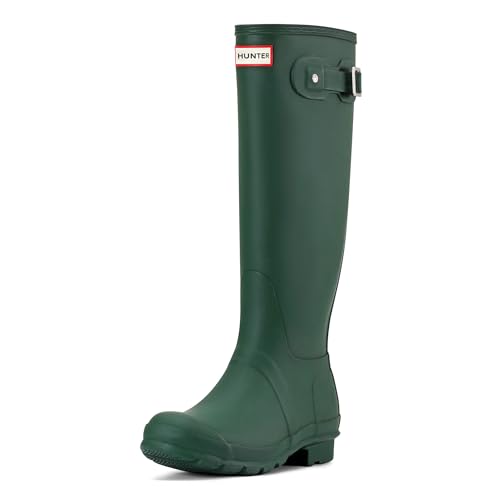
This is the boot most people mean when they say Hunters. It’s natural rubber, handmade from 28 separate parts, with a textile lining and a slim, tailored leg.
The leg is the thing to check. It suits slim and average calves, but if you have bigger calves, look at Hunter’s adjustable or wide-calf versions instead.
For sizing, follow the rule above: your normal size if you’re a whole size, the size below if you’re a half size with a slim foot.
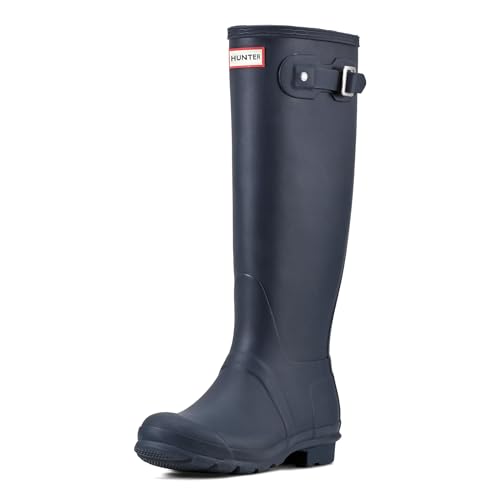
The Play Tall is Hunter’s lighter, more casual tall boot. It’s still vulcanised natural rubber, but it has a different shape and usually costs less than the Original.
The fit isn’t identical to the Original Tall, so don’t assume your size carries over. Check the chart on the listing, and try both on if you can.
Half sizes and socks
Hunter only makes whole sizes, so if you're a 5.5 you'll be choosing between a 5 and a 6. Your socks decide which one works.
A thin sock in a boot that's half a size big lets your heel lift with every step. That rubs, and in a tall boot it also wears the lining at the back.
A thicker welly sock fills the space and keeps your foot in place.
Going too small is worse. The HSE's advice on bunions says to avoid tight, pointy shoes, and a cramped welly squeezes the toes just the same. If your toes touch the end when you stand up, go up a size.
Keep your socks dry, too. The HSE's page on athlete's foot says you're more likely to get an infection if your feet stay wet or sweaty. Rubber doesn't breathe, so change your socks after a long day in the boots. A heated airer dries socks and insoles overnight.
Calf width
A tall Hunter has to fit your leg as well as your foot. Measure the widest part of your calf while standing, then compare it with the calf measurement for your size on the listing.
If your calf is bigger than the chart allows, don't size up the foot to get a wider leg. Choose a Hunter with an adjustable side buckle or a wide-calf version instead.
If you have wide feet as well, our guide to wellies for wide feet lists boots with more room in the foot and the leg. Our guide to the best wellies for women includes shorter and stretchier styles.
Hunter sizes for children
Children's Hunters follow the same rule of whole sizes only.
The HSE's guide to choosing shoes for children says there should be about 1cm of space between the toes and the tip of the shoe, and that a trained fitter should measure a child's feet before you buy.
The same guide notes that rubber wellies don't breathe, but they're perfect for short spells of splashing and walking in mud. For younger children, our page on wellies for toddlers covers lighter, cheaper boots that suit small feet.
Getting a good fit to last
A Hunter that fits well on day one can feel different after a winter. Natural rubber softens a little with wear, especially around the ankle.
Look after the rubber and it keeps its shape. Nokian Footwear, the Finnish boot maker, says in its rubber boot care guide to dry rubber boots at room temperature and store them upright, out of direct sunlight.
Folded or squashed boots crease, and creases are where rubber cracks.
With the Irish weather, they'll get plenty of use. Met Éireann describes the Irish climate as shaped by the Atlantic, with frontal rain and heavy showers through the autumn.
Our guide to drying wet wellies shows how to get them dry overnight, and Hunter vs Dunlop compares the Original with Dunlop's work boots.
Hunter sizing: quick answers
Do Hunter wellies run big?
Many people find the Original Tall slightly generous in the foot. If you’re a half size, going down usually works. If you’re a whole size, buy your normal size.
Should I size up in Hunter boots for thick socks?
Only if you’re a half size or you have wide feet. For most whole sizes, your usual size leaves room for a welly sock.
What if my calves are too big for Hunter wellies?
Don’t go up a foot size to fix it. Look for the adjustable or wide-calf versions of the Original Tall, which open up the leg without changing the foot.
Do Hunter wellies stretch?
Natural rubber softens a little with wear, but it won’t stretch much in length or width. Buy the size that fits now.