
Every plug-in heater turns 1kW into the same heat for the same 36c. Where the real savings are: thermostats, timers, heating one room and a heated throw.
There's no such thing as a cheap-to-run plug-in heater. An oil-filled radiator, a fan heater, a convector and a halogen heater all turn electricity into heat at almost exactly the same rate: one kilowatt in, one kilowatt of heat out.
At the typical Irish rate of 36.06c/kWh, any 2kW heater on full costs 72c an hour.
What changes the bill is how long it runs and how much space it's trying to heat. That's where the real savings are, and the biggest one doesn't involve a heater at all.
Why they all cost the same
Plug-in heaters work by passing current through a resistance, and all of that energy ends up as heat in the room. The types differ in how they deliver it, not in how much they make.
- Oil-filled radiators warm slowly and keep giving off heat for a while after they switch off. Gentle and quiet, which suits a bedroom.
- Convector heaters warm the air directly and spread it around the room fairly quickly.
- Fan heaters blow hot air, so you feel the heat within a minute. Noisier, but good for short bursts.
- Halogen and infrared heaters warm you and the objects in front of them rather than the air, which works in a draughty room where heated air wouldn't stay put.
The one genuine exception is a heat pump, which moves heat from outside rather than making it, and can deliver three or four units of heat per unit of electricity. Those are fixed installations, not plug-in heaters.
Heater claims worth ignoring
They use exactly as much electricity per hour of heat. The oil stores heat, so they feel gentler and keep warming briefly after switching off.
Per kilowatt, no. Because they warm you directly, you may feel comfortable with the room a little cooler, which can mean less running time.
A room loses heat all the time it’s warmer than outside. Heating it when nobody’s there just pays for that loss.
On a thermostat, the bigger heater reaches the set temperature sooner and then cycles off. Running cost depends mostly on how fast the room loses heat.
What each one costs per hour
Cost per hour at Irish rates
| Electric blanket (60W) | 2.2c at the standard rate, 0.9c on a night rate |
| Heated throw, typical (100W) | 3.6c at the standard rate, 1.5c on a night rate |
| Heater on 1kW (1,000W) | 36.1c at the standard rate, 15.4c on a night rate |
| Heater on 2kW (2,000W) | 72.1c at the standard rate, 30.7c on a night rate |
| Heater on 2.5kW (2,500W) | 90.2c at the standard rate, 38.4c on a night rate |
That table makes the case for the cheapest option on it. A heated throw or electric blanket warms you rather than the room, for around a twentieth of the cost of a heater on full.
For an evening on the sofa or getting into a cold bed, nothing comes close.
Where the real savings are
- Use the thermostat, not the power switch. Set it to the temperature you want and let it cycle on and off. A heater without a thermostat runs flat out until you turn it off.
- Use a timer. Warm the room for the half hour before you use it, not all evening. A built-in 24 hour timer does this automatically.
- Heat the room you're in. Close the door and heat one room well rather than the whole floor badly.
- Warm yourself first. A heated throw on the sofa, with the heater on a low thermostat setting, is the cheapest way to be comfortable.
Two we'd buy
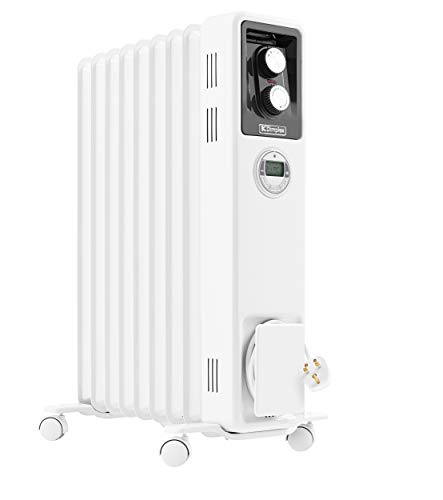
This has the two features that actually save money: a thermostat and a 24 hour timer. Set the room temperature you want and the times you want it, and it does the rest.
On full it costs 72c an hour at the standard rate, like any 2kW heater, but it will spend much of its time switched off once the room is warm.
It’s an oil-free column heater, so it’s lighter than an oil-filled radiator and warms up faster, with near-silent running that suits a bedroom. Dimplex is part of Glen Dimplex, the heating group headquartered in Co. Louth.
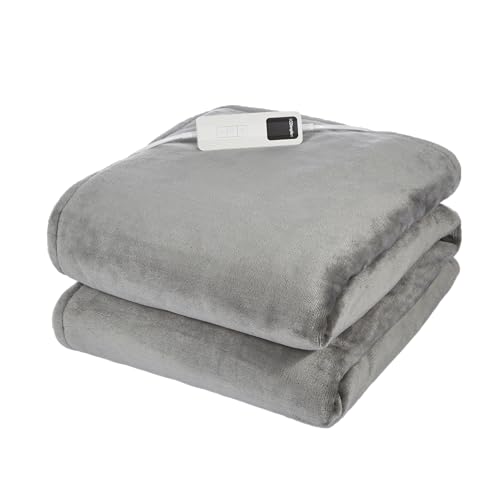
A big 180 by 130 cm throw with nine heat settings and a timer that switches it off, so it’s safe to doze under.
Dimplex quotes running costs of around 4p an hour at UK prices; at Irish rates expect a few cent an hour, a small fraction of any heater.
The controls detach so the throw can go in the washing machine.
Cold rooms, condensation and damp
Saving on heating has a catch in an Irish home. A room that's left cold all day has cold walls and cold windows, and that's exactly where condensation settles. Weeks of it and you get mould.
Respond, the Irish housing association, recommends a constant low level of heating, ideally 18°C to 21°C, over letting the house get very cold and then warming it up again.
A thermostat and timer let you do that without paying to heat empty rooms at full power.
If your windows are wet every morning, our condensation guide explains the free fixes. To compare a heater with anything else in your house, try the appliance running cost calculator.
Ireland has the dearest household electricity in the EU, according to Eurostat, so every hour a heater isn't running matters more here than almost anywhere else in Europe.
Plug a heater straight into a wall socket rather than an extension lead, and keep it a metre from curtains and bedding. Never dry clothes on it.
Turn it off before you go to bed unless it’s designed to be left on, and check the cable for heat or damage each winter.