
Laundry mode, drainage and night-rate running: the two dehumidifiers we'd buy to dry a family's washing indoors, and what each load really costs.
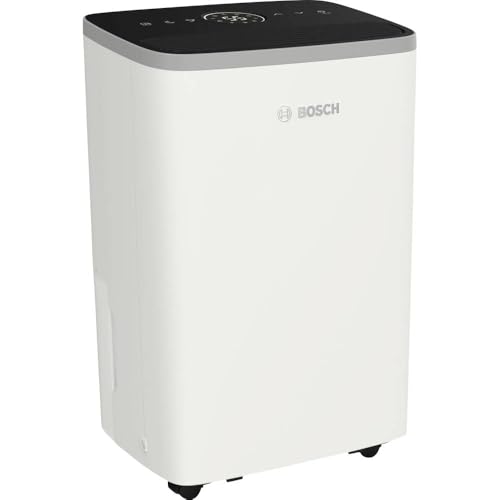
For a household that washes most days, buy the Bosch Dry 4000. It removes up to 16 litres a day, has a dedicated laundry mode and covers rooms up to 33 m².
If you dry clothes in a cold utility room or a box room with the radiator off, the EcoAir DD3 Slimline is the better choice.
It's a desiccant model, so it keeps working in the cold and blows warm air straight across the airer.
Why a dehumidifier dries clothes at all
Washing dries when the air around it can take up more water. On a dry, breezy day that's the air outside.
In an Irish winter it often isn't: Met Éireann describes the run of cloudy, humid weather with rain, carried in on Atlantic depressions, as typical of the Irish climate.
Indoors, a closed room fills up with moisture from the clothes within an hour or two. Once the air is saturated, drying slows to a crawl and the water starts settling on the windows instead.
A dehumidifier keeps pulling that water out of the air, so the air never fills up.
The clothes keep drying at the same pace, and the water ends up in a tank instead of on the glass or in the walls.
What makes one good for laundry
Any dehumidifier will help. These four features make the difference between a load that's dry by morning and one that's still damp at lunchtime.
- A laundry mode. It runs the fan and compressor flat out for a set time, then switches off. Without one, a humidity setting will throttle back just when you want it working hardest.
- Enough capacity. A single person's load can manage with a 10 to 12 litre model. A family washing every day needs more, and 16 litres or above is a sensible target.
- Directed airflow. A louvre that swings or points lets you aim the dry air at the clothes. Air moving over wet fabric matters almost as much as dry air.
- Continuous drainage. A big load can fill a 2.5 litre tank overnight. A hose outlet to a sink or floor drain means it never stops halfway.
 01
01
Bosch rates the Dry 4000 at up to 16 litres a day, the most of any dehumidifier we found from an Irish seller. That headroom is what you want when there’s a load on the airer most evenings.
Its laundry mode runs it at full power to get a load dry, and night mode drops the fan for when it’s in a bedroom.
It runs at 38 dB(A), according to Bosch’s own product page, and rolls easily between rooms on its wheels.
Bosch doesn’t publish an average wattage. European retailers list a maximum of 285W, which puts a six hour laundry session at no more than 62c, or 26c on a night rate.
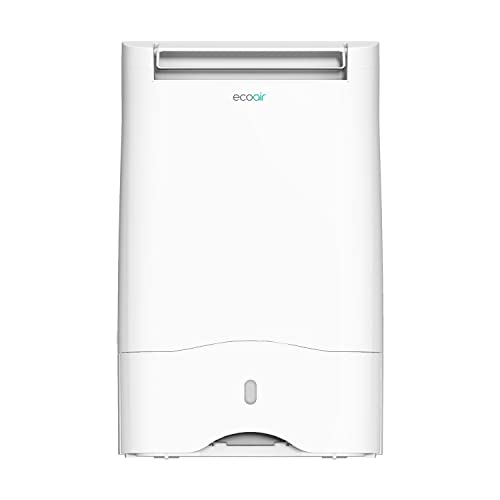
Utility rooms and garages are often the coldest rooms in an Irish house, and that’s exactly where a compressor dehumidifier struggles. This desiccant model is rated to keep working at temperatures as low as 1°C.
It also suits laundry for a second reason. A desiccant puts out warm air, and the DD3’s swinging louvre spreads it across the whole airer. Warm air that keeps moving is what dries clothes fastest.
It weighs just 6.8 kg. It also comes with a hose for continuous drainage and a three year warranty.
EcoAir doesn’t publish its wattage; desiccants like this typically draw 330W to 650W, so it costs more per hour than the Bosch.
What a load costs to dry
These are worst-case figures, with each machine running flat out. Drying times depend on the load and the room.
Cost per load at 36.06c/kWh and a 15.37c night rate
| Bosch Dry 4000, 6 hours at up to 285W | up to 62c a load, or 26c on a night rate |
| Desiccant, 5 hours at 330W | up to 59c a load, or 25c on a night rate |
| Desiccant, 5 hours at 650W | up to €1.17 a load, or 50c on a night rate |
| Tumble dryer, 2,000W for 1.5 hours | up to €1.08 a load, or 46c on a night rate |
Apart from a desiccant on its high setting, every option here beats a vented tumble dryer, and the compressor model beats it by a wide margin. Run any of them on a night rate and the saving gets bigger again.
A heated airer in the same room cuts the drying time further for a few cent more an hour. Our heated airer guide covers that set-up and its costs.
Setting up a drying room
-
Pick the smallest room you can
A box room or utility dries far faster than a living room, because the dehumidifier has less air to work on. On the humid days Met Éireann describes as typical of Irish weather, that matters even more.
-
Shut the door and window
Otherwise you’re drying the rest of the house and the street outside. Open the window to air the room once the load is dry.
-
Put the dehumidifier close to the clothes
About a metre from the airer, with the louvre or outlet pointed at the washing. Leave gaps between items so air can move through them.
-
Set laundry mode and a timer
On a day/night meter, start it when the night rate begins. Respond, the Irish housing association, also advises keeping wet towels off the bathroom radiator, where they add moisture straight to the air.
That’s the situation for a lot of apartment renters, and a dehumidifier is the best answer to it. Drying indoors without one is a common cause of condensation and mould, so a dehumidifier protects your health and your deposit.
If damp or mould is appearing despite that, the landlord may be responsible. Our guide to damp in a rented house explains your rights.
For quieter running in a bedroom, or a model with a built-in air filter, our guide to the best dehumidifiers for Irish homes compares five options.